iOS
The calisthenics app that tests you before it programmes you.
Most apps hand you a twelve-week plan on day one. This one measures what you can hold today, places you on a 138-step ladder, and will not move you up a step until you hit the target twice.
The test runs in your browser. No account, no card, about nine minutes.
What it actually does
01
Tests you
Five to thirteen holds and rep counts, depending on the skill. You type in what you managed. A zero still counts.
02
Places you
Your level comes from the median of your attempts, not your best one. Three tries of 5s, 4s and 4s is a four-second hold that got lucky once.
03
Prescribes the next step
You train the step above the one you own, with the cleared step kept behind it as support volume. Sessions fit the minutes you said you had.
Why the plan is different from a programme
These are the decisions the engine actually makes. Each one is a thing you can check against your own training rather than an adjective.
- It advances on evidence, not on the calendar.
- A step moves up when you hit the target at an effort of 8 out of 10 or below, twice in a row. One good night does not promote you and one bad night does not demote you.
- A weak link is trained at its own level, not yours.
- If your compression is miles behind your pressing, the plan trains compression from its first step with extra sets, while your pressing carries on where it is. Most programmes move everything together at the pace of the strongest thing.
- Set length scales to the hold, not the level.
- Six sets of ten seconds beat two sets of twenty where there is room below your maximum. On a four-second advanced tuck there is no room, so it prescribes work at maximum instead.
- It will refuse you once.
- Straight-arm work loads the wrist harder than anything else in training. If the wrist check is not passed you get two weeks of wrist conditioning and a re-test, not a plan. The clock on that check stops at 40 seconds, so there is nothing to gain by holding through pain.
The ladder
Fourteen skills across six families, from a first pull-up to the full planche. Every step has a name, a number and a target you can test — no "intermediate" or "advanced" doing the work of a measurement.
138
steps, each with its own pass and mastery target
32
parallel branches, so a bar and a floor are different routes
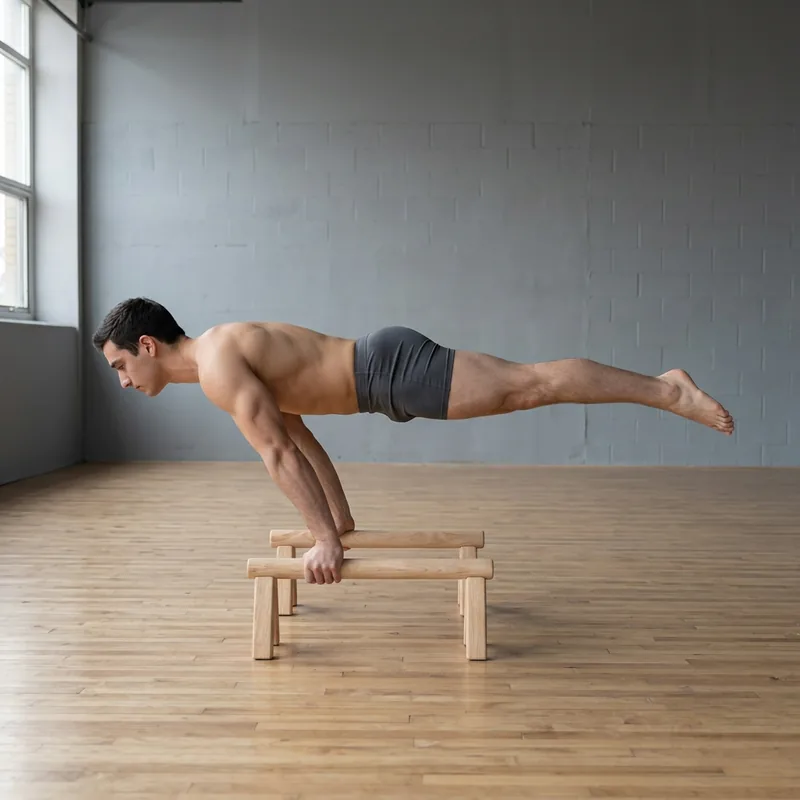
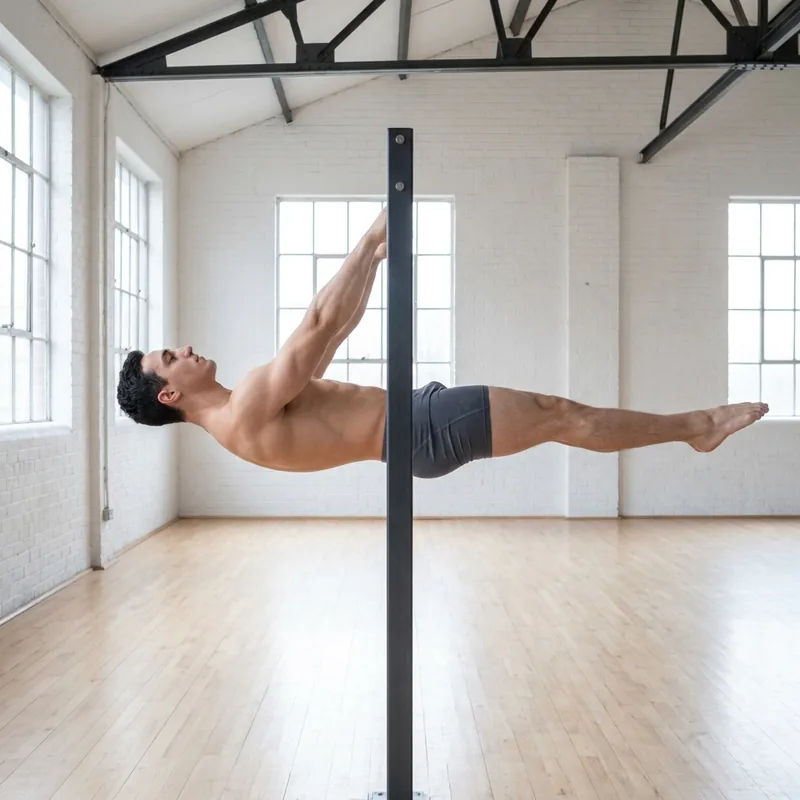
Planche · front lever · back lever · human flag · handstand · handstand push-up · muscle-up · pull-up · one-arm push-up · L-sit · ring support · dragon flag · pistol squat · planche lean.
What it cannot do
Worth saying plainly, because every fitness app claims the opposite.
- It cannot see your form. You type in a number; it cannot tell whether your back was flat. Film yourself, or train with somebody who can watch.
- The difficulty ratings are ours. The order of the progressions follows established coaching, and the level-and-track model is adapted from the progression charts in Steven Low's Overcoming Gravity 2. The specific level on each exercise, and every pass target, we set ourselves. They have not yet been validated against user outcomes and some of them will be wrong. We correct them as we learn.
- It is not medical advice. We are not physiotherapists. If something hurts, see someone qualified rather than re-testing to see if the number moved.
What costs money
| Part | Price |
|---|---|
| The tests, your placement and your whole ladder | Free. No account, no card. |
| The training plan and the session logger | £8.99 a month or £59.99 a year, after a 14-day trial |
Cancel in the App Store at any time. If we raise the price for new subscribers, yours stays where it is for as long as your subscription runs without a break — a commitment that is in the terms, not just on this page.
Questions
Do I need a gym or equipment?
No. Several skills — the planche, the handstand, the one-arm push-up, the pistol squat — need nothing but floor. Parallettes make the planche and L-sit more comfortable but are not required. The app asks what you own and only tests you on things you can actually do.
How is this different from a calisthenics workout app?
A workout app gives you sessions. This gives you a position on a ladder and the next step on it. The plan is generated from your own test numbers and changes when those numbers change, rather than running a fixed block to completion.
How long does the test take?
About nine minutes for a floor skill. Some tests only unlock if you clear the one before, so it is often shorter. Every answer saves as you go and you can stop and finish later.
Can I train more than one skill?
Yes, but one at a time is the recommendation and the app is built that way. Each skill gets its own plan from its own tests. Switching does not lose the progress on the one you leave.
Is there an Android version?
Not yet. iOS first. The free web test works in any browser on any device.
What happens to my data?
Your training numbers stay on your phone unless you add an email so they survive a new handset. There is no password — signing in is a link we email you. The privacy policy is written from the actual database schema.
Where the method comes from
None of the underlying coaching is invented here, and it is worth being specific about what is borrowed and what is ours.
- The level-and-track model — parallel movement tracks sharing one difficulty scale, with bands grouped the way gymnastics grades them — is adapted from the progression charts in Steven Low, Overcoming Gravity (2nd edition, 2016). Source: that book, which is the standard reference text for bodyweight strength progression.
- The difficulty bands follow the International Gymnastics Federation's A-to-C element grading, which is why an "A-Level" badge means something outside this app. Source: the FIG Code of Points.
- Autoregulation uses rate of perceived exertion on the 10-point scale. According to the reps-in-reserve research this is the established method for deciding whether to progress a load without testing a true maximum. The app advances a step at RPE 8 or below for two consecutive sessions, and cuts volume at 9.5 or above.
- The order of progressions within each skill is the consensus sequence across established calisthenics coaching — tuck, advanced tuck, straddle, full.
- The specific level on each of the 138 steps, and every pass and mastery target, is ours. Not taken from a source, not validated against user outcomes yet. That is the part most likely to be wrong and the part we most want corrected.
Who makes this
Isoletics is built by Gilvara Ltd, a company registered in Scotland (SC854313). Written and built by our founder, who trains these skills himself and who reads every report sent from inside the app. It is a one-person operation, which is why the ladder gets corrected in public rather than quietly, and why a bug report reaches the person who can fix it rather than a queue.
The position images on this site and in the app are generated illustrations of each hold, made so every step is shown from the same angle in the same room. They are not photographs of users, and no result on this page belongs to anybody but the engine that produced it.
Questions: support@isoletics.app